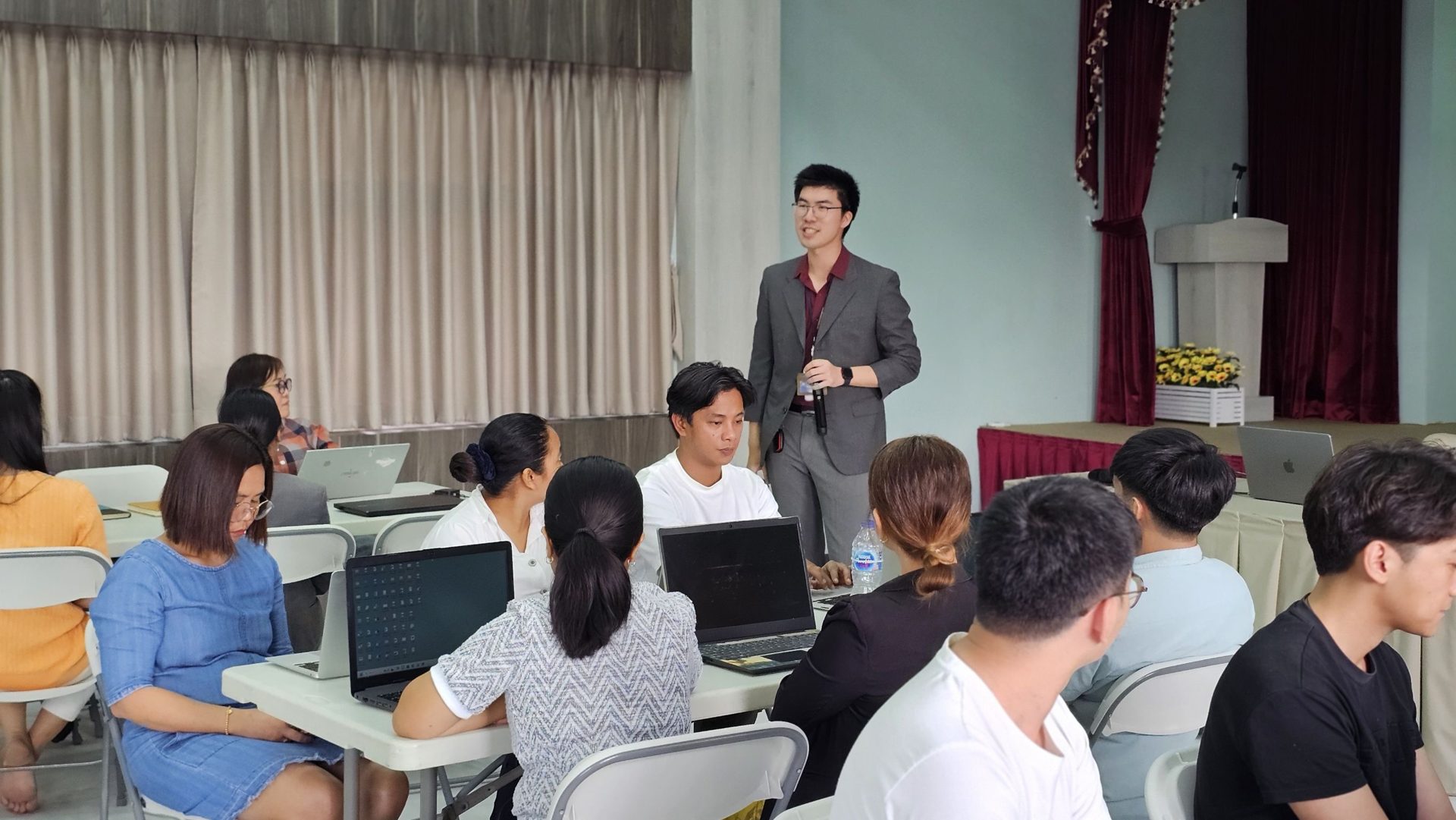
Run In Our Own Companies First
This is the curriculum we use to roll AI out inside our own family business group, then teach.
The whole programme at a glance — how it is structured, sequenced, and measured.
The curriculum is built on one rule. About seventy percent of every session is a shared core — identical for finance, sales, HR, operations, everyone. One company, one AI language, one safety standard. The remaining thirty percent is the use-case layer, swapped for each role, so people apply the same skill to the work in front of them.
This is what keeps a rollout coherent, and it is what makes it efficient: the core is reused every session, and only the examples change. See how the layer differs by role in the role tracks.
The curriculum is three parallel twelve-week tracks. They share one teaching spine — short demonstration, practice on a simulated case, application to approved real work, then reflect and refine — and one safety standard: no customer, personal, financial or internal data in an unapproved tool, and the person doing the work owns the decision and the outcome throughout.
Working fluency: responsible starting points, prompts that produce checkable work, document production, summarising and extraction, search and source-checking, Gems, a working AI Brain, NotebookLM, generating outputs from knowledge, the Data Refinery, purposeful media, and a closing real-work clinic.
The shift from instructing to thinking with: framing a problem, separating facts from assumptions and uncertainty, questioning the AI, generating alternatives, finding evidence gaps, continuous context, reflection loops, responsible data use, small reversible experiments, and a reasoned proposal as the capstone.
A map of capability categories rather than a list of app names: how models work and fail, general assistants, continuous assistants, knowledge tools, research tools, creative AI, AI embedded in everyday software, automation and agents, data governance, evaluating products without chasing them, and a team AI portfolio.
Each track is assessed on applied evidence rather than attendance: at least ten of twelve sessions attended, eight or more pieces of applied work submitted, each naming its inputs, its assumptions and limits, how it was checked, and who is accountable.
The twelve-week tracks above are the curriculum. This five-session shape is how an introductory engagement is usually packaged — a shorter route into the same core for a team that is starting from zero, with role-specific content inside it. It is deliberately simple: demystify and get one real result on day one, build the habit, deepen the use cases, sharpen the checking, then connect to a dashboard.
What AI is, the three rules, and one genuine task done live — a real result before anyone leaves the room.
AI drafts, summarises, and translates; the draft-read-correct-send habit starts to form.
Three or four repeatable prompts for the person's actual job, saved as reusable helpers.
Context, task, and format sharpened; the habit of catching confident-but-wrong answers.
Where a stronger tool earns its place — one account per department, introduced when the need is felt.
A team that wants the full depth takes one of the three twelve-week tracks instead. The shared foundation underneath both — the three rules, the prompt formula, data safety, and the maturity ladder — is set out on the foundation page.
The weekly report is the spine of the programme — it turns scattered experiments into a visible record. It starts trivially small and adds one layer each week, so it never feels like paperwork. By the last week it is tied to the person's job description and is the clearest signal of who is actually using AI at work.
Running the programme surfaced one finding twice, in separate cohorts: left to themselves, people summarise something about AI rather than using it on a real task. A summary is not the exercise. So every assignment forces an applied task — a draft you actually sent, a helper you reuse, a document you had to produce anyway. Applied work is what moves someone up the maturity ladder; a summary does not.
The homework is always the same shape: use AI on one real task from your own week, then note where it helped and where it fell short. That note becomes the next session's starting point.
The programme is tool-agnostic in principle and deliberately staged in practice. Teams start on one assistant to build the habit without confusion, and add a more capable tool only at the point where a dashboard or a heavier workload makes the case for it.
One assistant connected to email and calendar. Build the habit with a single tool before adding any others.
A more capable tool per department for dashboards and heavier work — introduced at Session 5, when the need is real.
The sequence matters more than the brand: build the discipline first, then let the tools follow the work. From there the path leads to Claude as a coworker, Claude Code, and an AI operating system.
This is the curriculum we use to roll AI out inside our own family business group, then teach.
The curriculum is not a course written to be sold. It is how our own family business group brings AI into daily work — the same foundation, the same weekly report, the same tooling path. We run it in our companies first, then teach it.
One shared foundation for the whole team, applied to each person's real work.
Request a consultation